



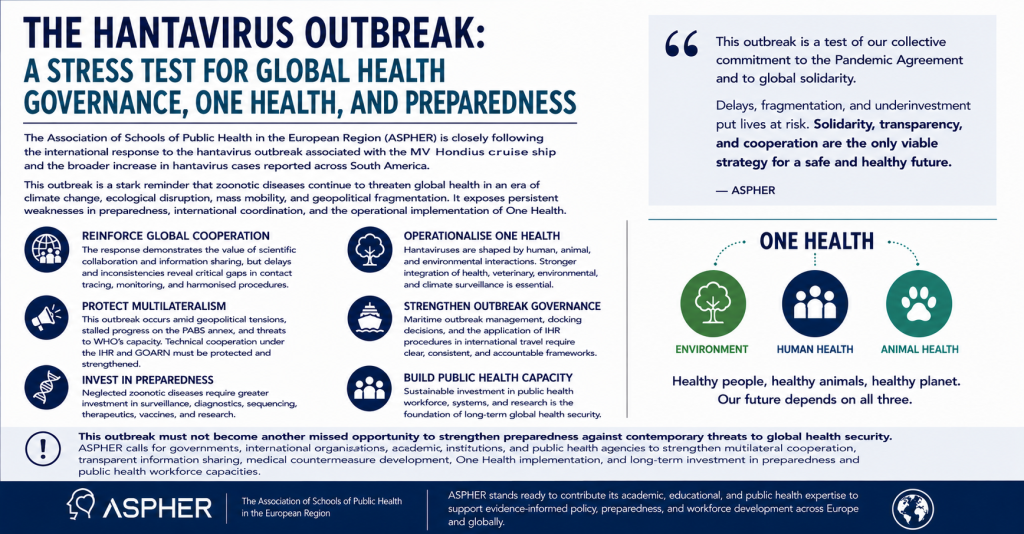
The ongoing Andes Hantavirus outbreak associated with the MV Hondius cruise ship serves as a critical stress test for global health governance, One Health, and international preparedness. Released by the ASPHER Public Health Emergencies Task Force, this statement highlights that, while the international response shows visible post-COVID progress in speed and transparency, the event simultaneously exposes deep vulnerabilities in current systems. It represents an initial operational test for the 2025 Pandemic Agreement and the updated International Health Regulations (IHR), proving that global health security remains overly reliant on fragmented national initiatives rather than a truly harmonized, multinational framework.These systemic gaps are further aggravated by geopolitical fragmentation, including stalled negotiations on the Pathogen Access and Benefit-Sharing (PABS) system and the formal withdrawal of the US and Argentina from the WHO, as well as a failure to sufficiently incorporate veterinary and environmental expertise into the live public health response. Furthermore, poorly harmonized global risk communication has allowed media outlets to amplify panic while leaving local communities unnecessarily alarmed. ASPHER urges governments and international bodies to break the chronic cycle of panic followed by neglect by making long-term investments in the public health workforce and building interoperable, cross-border platforms for real-time clinical and data sharing.
More information on this, and all of ASPHER emergency public health communications, can be found here: https://www.aspher.org/structures/public-health-emergencies/
Full statement: https://www.aspher.org/media/resources/2026/05/ASPHER-Public-Health-Emergencies-Hantavirus-outbreak-communication.pdf
Infographic: https://www.aspher.org/media/resources/2026/05/ASPHER_Hantavirus-outbreak_image.png