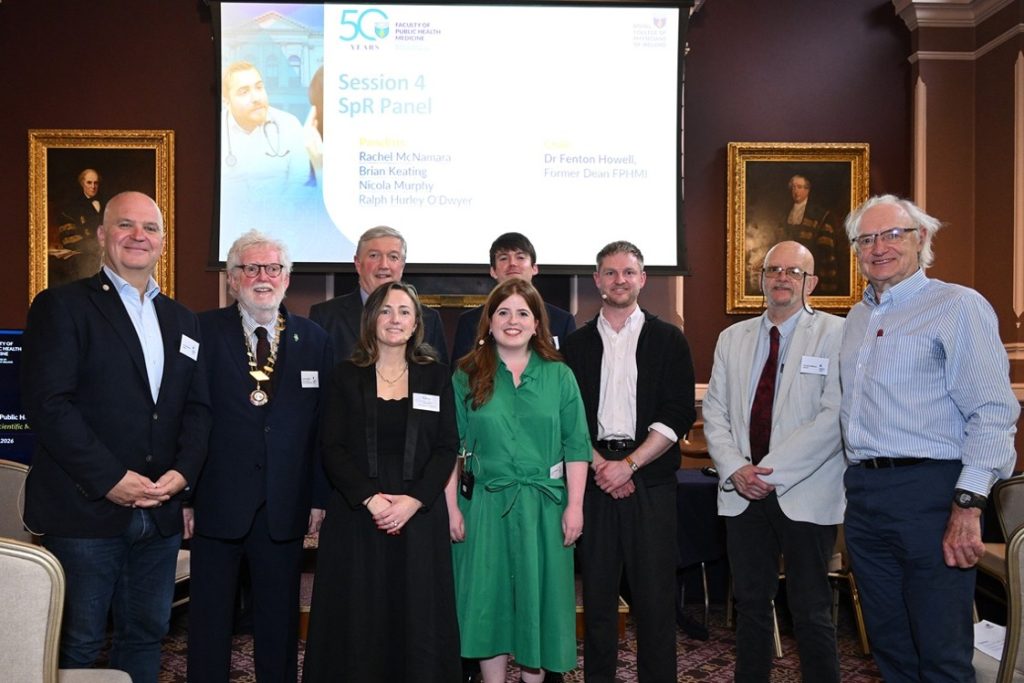
Session 4 of the Faculty of Public Health Medicine of Ireland Summer Conference, Registrar presentations on their aspirations for their future. With President of the Royal College of Physicians of Ireland, Professor Diarmuid O’Shea, Dr Tony Holohan, former Chief Medical Officer of Ireland, Dr Kevin Kelleher Dean of the FPHMI, and Dr Fenton Howell, formerly Dean FFPHMI. Photo RCPI, David Coleman and Bobby studios
In May, it was my good fortune to join colleagues from theIrish Faculty of Public Health in Dublin for their summer conference. I was honoured to be recognised and awarded their Honorary Fellowship. I delivered a presentation entitled, “Misneach i dtréimhsí dorcha ar son sláinte an phobail” (Courage in dark times for the health of the public). I reflected on GNAPH’s work as co-leaders on the World Health Organisation’s (WHO) Roadmap for public health workforce capacity and the challenges of carrying out this work in increasingly difficult circumstances. “There has never been a more important time to be in the service of the public’s health, and never a more difficult time. We are often engaged in scientific or technical exercises needing our expertise, but we need to reassert our reasons for being here; our vision, our values, that we are a vocation, and it seems to me that we need to restate those things, particularly in this climate.”
The day before their summer conference, Dean Kevin Kelleher organised a session for me to discuss a lifetime in public health, offering some lessons about my career from local to global over 40 years. ‘The future’s bright, the future’s public health’ was the title of my talk, and instantly attracted the question, “why do you say that?”
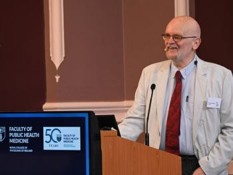
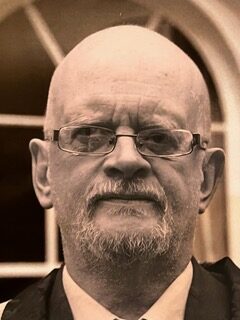
Prof John Middleton during his presentation Courage in Dark Times for the Health of the Public. Photo: Royal College of Physicians of Ireland, David Coleman, and Bobby studios.
Other students of public health have heard me say that over the years… They’ve also heard me say “working in public health is the best job in the world. You will never have boring days; you will never have two days the same. You may have difficult times, you may have dangerous times; your ‘patients’ are your ‘population’ – they will generally be well, and they will not need to follow your ‘prescription’ if they don’t like it, or understand it… In clinical practice, you can save lives one by one, in public health, you can save lives in millions. But you may not get noticed doing this, like the invisible expert referee in the football match, or the conductor in the orchestra, or the grit in the oyster, your contribution and handiwork may go unnoticed, unacknowledged. You are part of a collective activity, which requires leadership, partnership, and the full bloodied involvement of communities, and individuals, working together, in private, voluntary and public institutions from the global to the local level. In even better public health practice, your proposals are adopted, owned, even claimed by someone else as their idea …. Some say that is the highest achievement of public health practitioners…”
I was able to witness the expectation and belief in growing public health workforce, capacity, and competence in the South-South project meeting in Manila in June, which I joined online. Riegelman GNAPH Fellow Dr. Wen Ting Tong represented GNAPH and has written about this for the GNAPH website newsroom.
The United Kingdom Faculty of Public Health annual awards ceremony in June also reflected on these themes. The meeting celebrated the great wisdom, science and leadership of some notable senior figures in global public health. Sir Michael Marmot, Dr. Laura Magaña, Professor Mary Codd, Professor Sanjay Zodpey, amongst a galaxy of stars. Laura Magaña’s address can be found on the GNAPH site in the news post here.
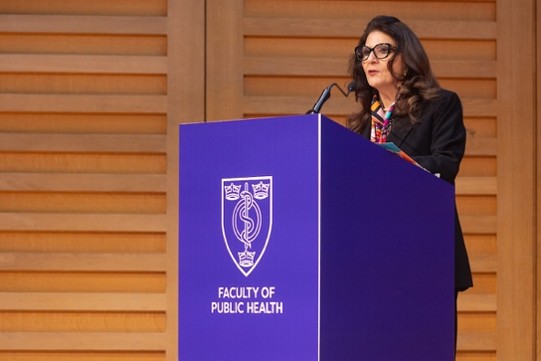
Dr Laura Magaña, President of the Association of Schools and Programmes of Public Health (ASPPH-USA) gives her acceptance speech on receiving the Honorary Fellowship of the Faculty of Public Health of the Royal Colleges of Physicians and Surgeons of the United Kingdom. Photo courtesy of UKFPH.
In equal measure, the UKFPH awards ceremony applauded the efforts of the new, the upcoming, the talented, the committed, the ambitious, and the future of public health. Like their Irish counterparts, the specialty registrars who spoke at the Irish Faculty Conference, these are people who know what they are up against, what they have to do, resolved, courageous, confident. These are the people that really give me belief in the future of the public health profession, system, service and vocation…. I am almost relaxed about their ability to look after me and my generation in the years when I do call it a day!
As if on cue last week I came across a conversation between public health social media influencer, Dr Jessica Knurick, and Professor Megan Ranney, Dean of Yale School of Public Health. I highly recommend the posts of Jessica Knurick, sometimes unpicking MAHA health influencers peddling their wellbeing products without science or declarations of interest, applying the playbook of disinformation. But what most grabbed me in the thoughts of Dean Ranney was that she too believes, ‘the future’s bright, the future is public health’. She says:
“…there is actually no better time to get a public health degree than now…. The first is, is that many of the systems and structures that we’ve depended on here in the United States and across the globe are actively being dismantled. We need well trained people who are poised to not necessarily rebuild exactly what we had, but to build a better future. And so a year or two years from now, the world is going to need you in a very different way from how it needs you right now. And so getting that advanced training and understanding data and understanding behavioral science, understanding health policy, holy cow, like you are going to be in high demand within the world of kind of traditional public health. The other side of it is that that skill set, those kinds of scientific steps that I described that are part of what public health is. Those can be used in any of a gazillion different professions and specialties and worlds. And so the second reason for me to get the public health degree is it like it just opens up this kind of wealth of opportunities that are not as available with other degrees.”