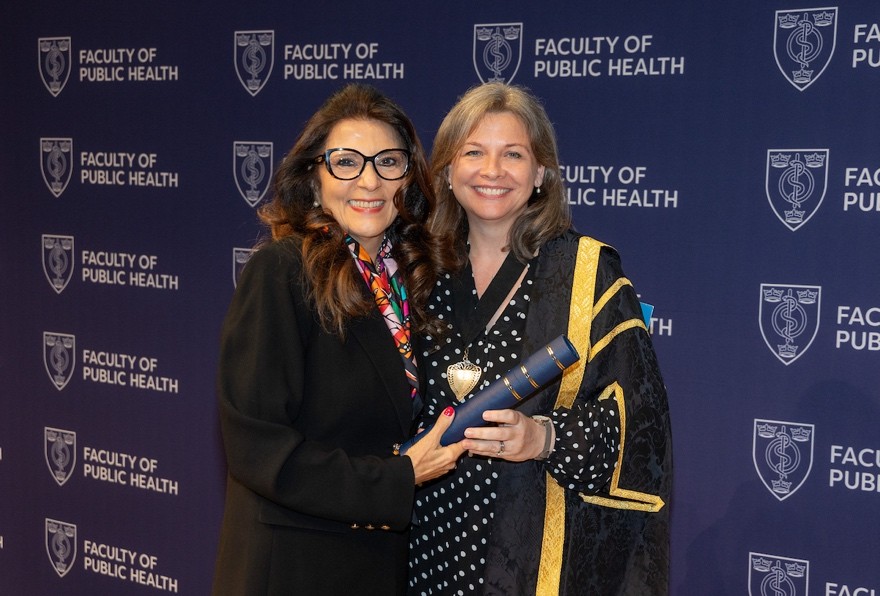
Feature Photo: Dr. Laura Magaña (left), GNAPH Founding President, and Professor Tracy Daszkiewicz PrFPH (right), UK Faculty of Public Health President. Photo courtesy of UKFPH.
The Global Network for Academic Public Health congratulates Dr. Laura Magaña, founding president of GNAPH and president and CEO of ASPPH, on being awarded an Honorary Fellowship with the UK Faculty of Public Health. Below is the transcript of her acceptance speech.
Good evening distinguished colleagues, honored guests, and friends,
I am deeply humbled and truly honored to accept this Honorary Fellowship from the Faculty of Public Health. To receive the highest recognition bestowed by such a respected institution is profoundly meaningful to me, both personally and professionally.
The Faculty of Public Health has long been a powerful voice for prevention, equity, evidence, and the protection of communities. Its leadership has helped shape public health practice not only in the United Kingdom, but globally. I am incredibly grateful to join this distinguished community.
My journey in public health began many years ago in Mexico, where I first witnessed how deeply health is shaped by social conditions, education, opportunity, and public policy. Since then, I have dedicated more than three decades to advancing academic public health through education, leadership, workforce development, global collaboration, and institutional transformation.
I have had the privilege of serving as Dean of the School of Public Health at Mexico’s National Institute of Public Health and now as President and CEO of the Association of Schools and Programs of Public Health. I also had the honor of serving as Founding President of the Global Network for Academic Public Health, working alongside colleagues across regions and countries to strengthen academic public health worldwide.
Throughout my career, my work has centered on helping reimagine the future of public health education – preparing leaders who are capable of responding to increasingly complex global challenges with scientific rigor, compassion, innovation, and courage.
What this Honorary Fellowship means to me is not simply recognition of past accomplishments. I see it as a shared commitment to the future of our field and to the responsibility we all carry as public health leaders, educators, scientists, and advocates.
And I truly believe the future of public health will require us to think and lead very differently.
For much of the last century, public health focused primarily on controlling infectious diseases, improving sanitation, strengthening healthcare systems, and extending life expectancy. Those achievements transformed humanity. But the challenges we face today are broader, more interconnected, and more complex than ever before.
Climate change is no longer only an environmental issue; it is a health issue. Artificial intelligence is not only a technological issue; it is a public health issue. Loneliness, misinformation, political polarization, migration, aging populations, urbanization, mental health crises, declining trust in institutions, and widening inequities are all profoundly shaping health outcomes across the globe.
The future of public health, therefore, cannot remain reactive. It must become predictive, preventive, proactive, data-driven, digitally enabled, and deeply human-centered.
We must move from treating illness to creating the conditions that allow people and communities to thrive across the life course.
This means that the future workforce of public health must be educated differently. We must prepare professionals who can work across disciplines and sectors – individuals who understand epidemiology and data science, but also ethics, communication, systems thinking, diplomacy, policy, leadership, and community engagement.
The public health leader of the future must be as comfortable discussing artificial intelligence and climate resilience as they are discussing biostatistics and disease prevention.
At the same time, we must ensure that innovation never comes at the expense of humanity.
As we embrace AI, digital health, precision medicine, and advanced analytics, we must remain grounded in ethics, equity, inclusion, and human dignity. Technology should amplify compassion, not replace it. Data should empower communities, not deepen disparities. Innovation should strengthen trust, not erode it.
I believe academic public health institutions have a special responsibility in this transformation.
Our schools and programs must become engines of lifelong learning, innovation, and societal impact. We must create learning environments that are flexible, interdisciplinary, globally connected, and responsive to rapidly evolving workforce and societal needs. We must prepare resilient learners capable not only of adapting to change, but of leading transformation itself.
And perhaps most importantly, we must restore and strengthen public trust.
In an age of misinformation and division, public health cannot rely solely on evidence; we must also communicate with empathy, humility, transparency, and authenticity. Communities must not simply be recipients of public health interventions; they must be true partners in shaping solutions.
I remain profoundly optimistic because I see extraordinary talent, passion, and commitment in the next generation of public health professionals around the world. They are bringing new energy, new perspectives, and a deep commitment to justice, collaboration, and innovation.
Our responsibility is to support them, mentor them, and create systems that allow them to flourish.
Because ultimately, public health is an act of hope.
It is the belief that through science, education, partnership, and collective action, we can create healthier, more equitable, and more resilient societies. It is the belief that every community deserves the opportunity not only to survive, but to thrive.
I accept this honor with immense gratitude and humility, and I share it with the many mentors, colleagues, students, collaborators, and friends who have walked alongside me throughout this journey.
Thank you for this extraordinary recognition, and thank you for your continued leadership and commitment to advancing public health for everyone, everywhere.