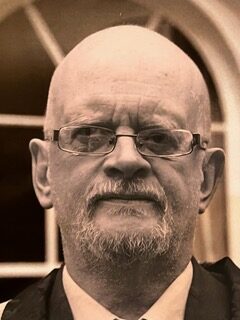
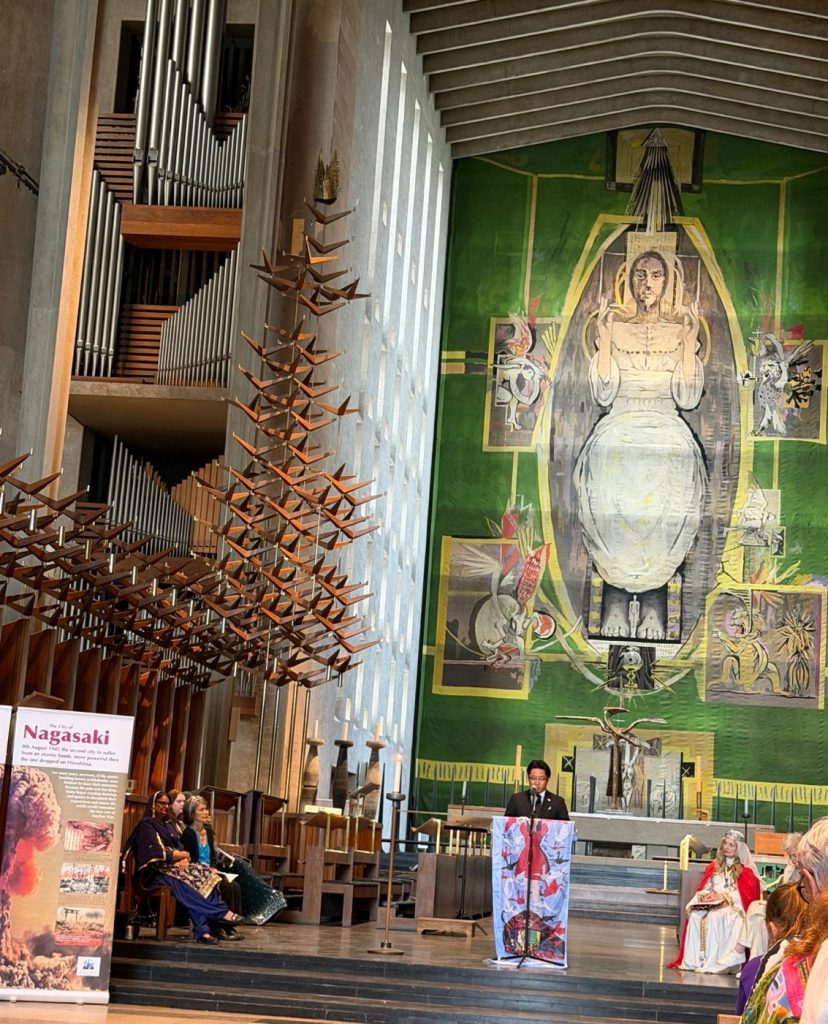
On August 6th I attended the annual Coventry Cathedral commemoration of the bombing of Hiroshima and Nagasaki with atomic bombs. The Coventry Lord Mayor’s Committee of Peace and Reconciliation organises the remembrance every year and joins with representatives of the Japanese government and Coventry’s twin city, Hiroshima. An extract of their statement marking the occasion is published in the box below.
“We remember Hiroshima. The Japanese city where the first atomic bomb was dropped on 6th August 1945. The effect was devastating. At least 100,000 people were killed instantly or in the first few days and many more died later due to radiation. The mental and physical suffering of the hibakusha who survived but suffered the effects of radiation continued for the rest of their lives.
“Coventry also suffered extensive destruction during the second world war. On the night of the 14th November 1940 there was a terrifying aerial attack with high explosive and incendiary bombs. More than 4,300 homes in Coventry were destroyed along with most of the city centre including hospitals and the cathedral. Over 560 people were killed and many more were badly injured.
“World War II could have been the war to end all wars, with the deaths of 75 million people, but hopes that humanity had learned a lesson and wars would end did not materialise. Today wars between Russia and Ukraine, Israel and Palestine/Hamas and Hezbollah in Lebanon are ongoing. There is ethnic violence and civil war in Sudan, civil war in other countries including Ethiopia, Somalia, Mozambique, Central African Republic, Myanmar, Colombia, Afghanistan and Yemen. Terrorist insurgency prevails in Nigeria, Iraq and many other countries.
USA’s and Israel’s attack on Iran to eliminate the possibility that they will develop nuclear weapons has provoked retaliatory attacks by Iran and its allies on Israel and gulf states. Countries hosting US bases – Qatar, Bahrain, Jordan, the United Arab Emirates (UAE), Kuwait and US-allied Oman and Saudi Arabia were all attacked by Iran even though they were not engaged in hostilities. The escalation of war to countries not originally engaged in the conflict has been shown throughout history, not least in the First World War. Today Russia’s war in Ukraine has led to alarm among European countries and increased spending on arms.”
Coventry Lord Mayors Peace Committee statement, August 6th 2026
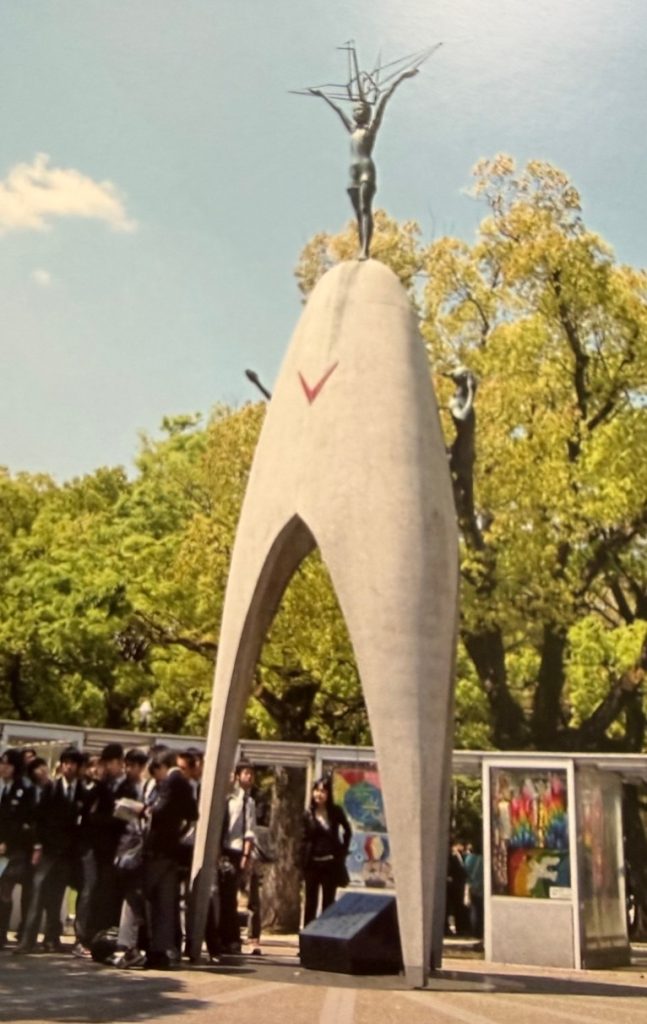
One of the hibakusha who survived, but suffered the effects of radiation until it ended their lives, was Sadako Sasaki. She was a two-year-old girl who lived in Hiroshima and was exposed to radiation from the bomb; she became fatally ill with leukaemia eight years later. She was told a legend that if you made a thousand paper cranes you could have a wish that would come true. The making of paper cranes has come to symbolise hope and a desire for peace and reconciliation. Although she died before creating 1000 cranes, other children took up the mantel, eventually raising enough money for the lasting Children’s Peace monument in the Peace Memorial Park of Hiroshima.
In Coventry, the annual ceremony involves the exchanges of greetings between the Mayors of Coventry and Hiroshima and a message on behalf of King Charles III’s representative by the Deputy Lord Lieutenant of the West Midlands, David Moorcroft. Coventry remains committed to its name as ‘City of Peace and Reconciliation’ working with many cities around the world which have experienced the destruction and recovery from war.
In Hiroshima the active promotion of peace through the stories of the hibakusha continues. The testimonies of survivors have been recorded because there are not many of them left to tell their stories. Takiguchi Sakae, one of the Hiroshima bomb survivors said: “Everyone is different. And if we learn to accept each other’s differences, the world would be much more peaceful.
What are the lessons for today?
The Bulletin of Atomic Scientists believes we are even closer to midnight on the clock of nuclear disaster – by design, accident, or miscalculation, or the lust for destruction of powerful men – with more nuclear flashpoints than ever before – Taiwan-China, North Korea, India-Pakistan, Israel, US against Iran, Russia in Ukraine…
The drive to re-arm is not for defensive weapons but for faster, earlier strike capabilities. In the current UK defence review, a greater proportion than ever before will be spent on nuclear weapons; making the UK the third largest spender on nuclear weapons after USA and China. All of this adds to international distrust, instability, and the prospect of war by accident or miscalculation.
In the context of global, ‘geopolitical health’, neoliberal policies have created ever greater inequalities in income between the super-rich and the extremely poor, between countries and within countries… Culture wars, funded by billionaires, tech, military and fossil fuel interests, blame migrants, minorities, other religions and other countries for the abject poverty and cruelty ordinary people face in their daily lives. Even in Japan, there has been a rise in fear of outsiders. Japan is increasing its arms spending towards a 2% share of GDP.
Coventry’s Alternative Employment Research, ‘CARE’,1986-1994: military industry can be directed to healthier, socially useful purposes
More than forty years ago I was involved in Coventry’s economic campaign to diversify from military industry – the Coventry Alternative Employment Research. The peace dividend was briefly in everyone’s thoughts with the fall of the Berlin Wall and the end of the Cold War. Peace was one of Four Dividends for a Healthier Future that I reflected on in my 2017 Milroy lecture for the Royal College of Physicians of London. Campaigners at the Cathedral reminded us of how tied up we are in the interests of the military-industrial-financial complex. Large portions of the West Midlands Councils Pension fund invested in British Aerospace (£12.2M), General Dynamics (£3.4M), Raytheon (RTX-£2.1M), Boeing (£1.6M), Lockheed Martin (£1.4M) and Northrop Grumman (£1.2M) Mark Bellis and colleagues have brought up to date the arguments for the peace dividend in his great series of papers for the BMJ in 2024 and 2025, the armaments industry as a commercial determinant of health. What appears to be new or at least more refined is how the tech interests normalise destruction and dehumanisation of others, through the games industry and through the active engagement of the military in media.
The destructive effects of the information revolution
More generally around the world, social media fuels and monetises hatred and mistrust – and normalises outrage, amplifies marginal belief and behaviour, and enhances the audiences of the extreme. All this while earning billions for the tech bros and helping them distract attention from where the real sources of everyday misery are coming from. In the information revolution, fear is a natural and permanent state of mind. Conflict becomes the expectation, and whole populations can be pacified and rendered helpless and manipulated.…. all this at a time when we all need to find peace, take action where we can, and step back from the abyss.
What does the public health community need to learn?
In recent polling in Britain, public opinion seems to understand that security is more than just protection from military danger – people recognise that climate insecurity, environmental and economic insecurity endanger them and their families and society as well. The Polish presidency of the European Union in 2025, Security Europe! recognised this need for societal protection. The public health community is well placed to convey the need for societies and governments to respond to all risks – military, health and social security, environmental, and economic risks. Basic biological needs are once again priority in the public health agenda food, clean water, shelter, clean air, and sound soil. We need better preparedness by governments and communities with key involvement from public health leaders. And we must end the nuclear arms race before it ends us.
In the public health community, concerns are growing about the prevention and management of all forms of violence – from domestic to global. There is renewed interest in the science and epidemiology of the effects, the prevention and response to war and conflict. In addition to our concerns about traditional aspects of the public health role during conflict, we must also reflect more deeply, our place in the active promotion of peace, and the recovery and rehabilitation. Health promotion is peace promotion, and the global health community has pursued the idea of health as a bridge for peace for many years. Progress of the WHO’s Global Health and Peace Initiative was presented at a meeting of the World Health Assembly in May. An updated road map is awaited. GNAPH has formalised its role in the Peace and health practitioners. Still much remains to be done.

Thanks
My thanks to David Fish, Secretary of the Coventry Lord Mayor’s Peace Committee, and for use of photos. Thanks also to the Lord Mayor’s Committee for their steadfast commitment to this Remembrance. Thanks to Frances and Chris Taggart for their contributions to the text.
The opinions expressed in this post are solely those of the author and do not necessarily represent the views of GNAPH or its members.
My reflections on the role of public health in conflict and war from this year can be found here:
President’s blog. A new year. A new resolve. A renewed moral compass for public health. GNAPH, January 30th 2026. https://globalnetworkpublichealth.org/a-new-year-a-new-resolve-a-renewed-moral-compass-for-public-health/
President’s blog. Gender is still a poverty and public health issues now more than ever. GNAPH, March 8th 2026. https://globalnetworkpublichealth.org/gender-is-still-a-poverty-and-public-health-issue-now-more-than-ever/
President’s blog. A war on the public’s health. GNAPH, March 10th 2026. https://globalnetworkpublichealth.org/a-war-on-the-publics-health/
WFPHA Global Public Health Week webinar. The Links Between Geopolitics and Public Health: A Joint WFPHA PET and GNAPH Webinar, April 8th, 2026. World Federation of Public Health Associations. Michael Moore (AUS) chair. Participants: Bettina Borisch, (CHE) CEO WFPHAs, Chuck Johnson (USA) IPPNW, Melissa Sweet, (AUS) Independent health and environmental journalist, Duha Shellah (PAL-CAN) John Middleton (UK) GNAPH, Mary Codd (IRE) ASPHER. https://www.youtube.com/watch?v=YZZeLS5YppU&feature=youtu.beEmpty heading
EUPHA Public Health Week. Health peace practitioners’ initiative. Peace, polycrisis and public health – Role, mission and mandate of public health professionals. Panel discussion. Friday 8th May 2026. European Public Health Association. Farhang Tahzib, chair, Bettina Borisch (WFPHA), Rachel Handley (UK) , Sara Lavinia Brair (Sudan), John Middleton (GNAPH) Erika Wichro (Int)Empty heading
Poster paper abstract. Konyard K, Levesque S, Middleton J, Codd M. Public Health Education in Times of Geopolitical Disruption: Developing a Subject-specific Curriculum in Geopolitical health. Royal College of Physicians Ireland (RCPI) Faculty of Public Health Medicine Summer Scientific Meeting 2026.19 and 20 May 2026. Irish Journal of Medicine. Ir Med j June 2026; 119 no 6: 119. Page 18 of book of abstracts https://imj.ie/royal-college-of-physicians-ireland-faculty-of-public-health-medicine-summer-scientific-meeting-2026/
Misneach i dtréimhsí dorcha ar son sláinte an phobail/ Courage in dark times for the health of the public .Key note for the Summer conference of the Faculty of Public Health of the Royal College of Physicians of Ireland, May 19th 2026. https://www.slideshare.net/slideshow/courage-in-dark-times-global-public-health-challenges-and-strategies/287662536
Short presentation for the Medicine Sans Frontieres side Event at the World Health Assembly, May 20th, 2026.Climate crisis peace and the right to health and healthy environment. Closing comments by Professor John Middleton. https://vimeo.com/1205481827
Centre for Health and Development Staffordshire University. CHAD/FPH Webinar. Middleton J. Geopolitical health a new imperative for understanding the health of the people we serve. Webinar lecture presented, June 8th, 2026. https://www.chadresearch.co.uk/chad-fph-webinar-geopolitical-health-a-new-imperative/ Speakers slides : https://www.chadresearch.co.uk/wp-content/uploads/2026/06/20260608-FINAL-delivered-middletonj-CHAD-middletonj.pdf You tube lecture presentation https://www.youtube.com/watch?v=ud_XFuP2USsEmpty heading
Geopolitics, ethics and public health. ASPHER 1st congress on public health education and training Milan, July 16-18th 2026. https://milan2026.aspher.org/programme.html Poster presentation. https://www.aspher.org/media/resources/structure_30/resource_57/Milan2026_P-01_Thu_1100-1230.pdfEmpty heading
Moderator Oral presentations XI: Emergency Preparedness; Disaster Management. ASPHER 1st congress on public health education and training Milan, July 16-18th 2026. https://milan2026.aspher.org/programme.html
https://www.aspher.org/media/resources/structure_30/resource_5 7/Milan2026_O-11_Fri_1515-1645.pdf