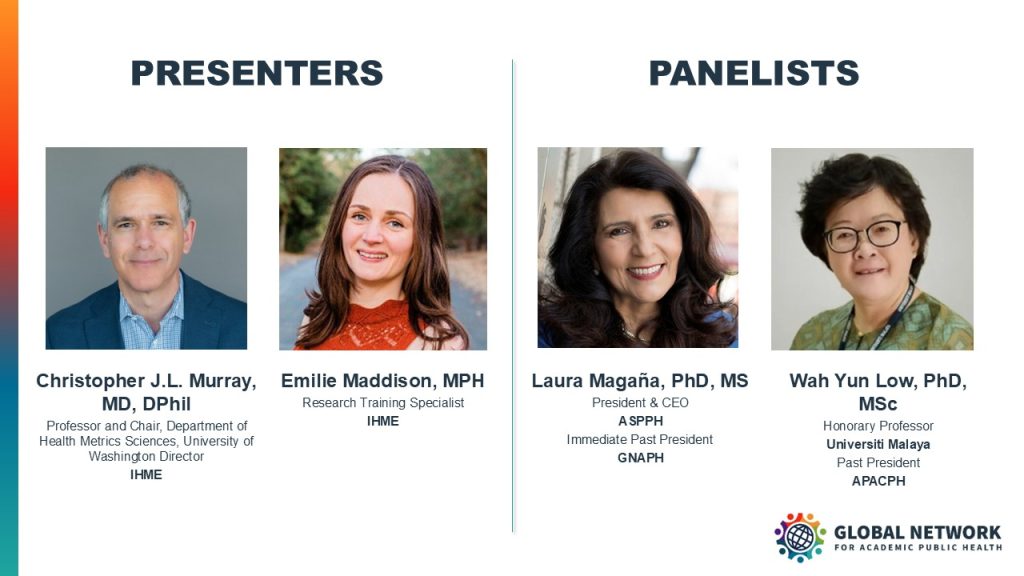
The Global Network for Academic Public Health (GNAPH) hosted the webinar, “From Data to Action: Global Burden of Disease and the Role of Academic Public Health,” on 27 May 2026, bringing together global experts to explore how the Global Burden of Disease (GBD) Study can support public health education, research, policy engagement, and workforce development. The webinar featured Prof. Dr. Christopher Murray, Chair of the Institute for Health Metrics and Evaluation (IHME), and Ms. Emilie Madison, Research Training Specialist at IHME. They were joined by panelists Prof Dr Laura Magaña, President and CEO of the Association of Schools and Programs of Public Health (ASPPH), and Professor Wah Yun Low, Past-President of the Asia Pacific Consortium for Public Health (APACPH) and President Elect of the GNAPH.
Understanding the Changing Global Burden of Disease
Dr. Murray presented key findings from the Global Burden of Disease Study 2023, one of the world’s most comprehensive efforts to measure health loss due to diseases, injuries, and risk factors across countries, populations, and time.
While substantial improvements in life expectancy and reductions in child mortality have been achieved globally over recent decades, the findings highlighted several major challenges facing public health today. One of the most striking observations was the persistence of profound health inequities. Regions such as the Sahel in sub-Saharan Africa continue to experience disproportionately high burdens of communicable diseases, maternal and child mortality, malnutrition, and conflict-related health challenges. In contrast, many middle- and high-income countries are increasingly dominated by noncommunicable diseases (NCDs) such as cardiovascular disease, diabetes, cancer, and chronic respiratory diseases.
The GBD 2023 findings also highlighted the growing importance of mental health, particularly among adolescents and young adults, with depression, anxiety, and self-harm contributing significantly to disability worldwide. At the same time, environmental and metabolic risks are becoming increasingly important drivers of health loss. Air pollution, extreme heat associated with climate change, lead exposure, obesity, hypertension, unhealthy diets, and high blood glucose levels now account for a substantial proportion of the global disease burden.
These trends demonstrate that public health challenges are becoming increasingly interconnected, requiring systems-based approaches that address not only diseases but also the social, environmental, economic, and political determinants of health.
Turning Data into Learning and Action
A key message throughout the webinar was that the GBD should not be viewed merely as a reference dataset, but as a powerful tool for academic public health.
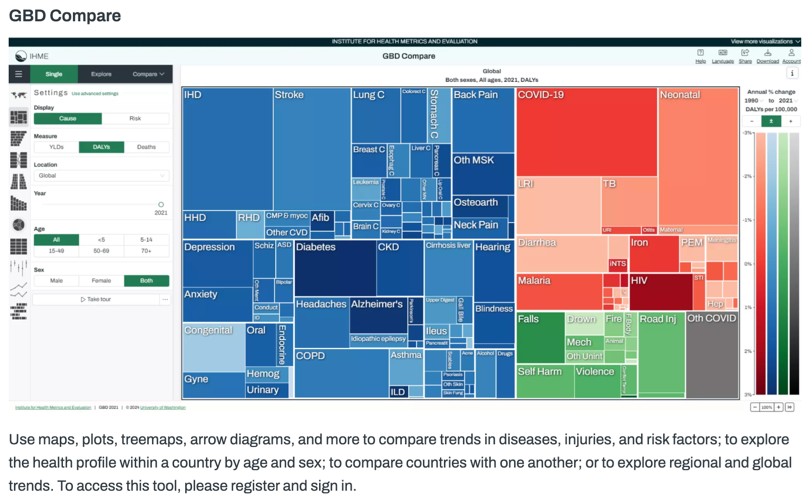
Ms. Emilie Madison demonstrated the many interactive facets of GBD Compare. This, and other similar tools, allow users to visualise and compare trends in mortality, disability, and risk factors across countries and regions, providing valuable opportunities for students, educators, researchers, and policymakers to explore real-world public health challenges through data-driven analysis.
Opportunities for Global Collaboration
Dr. Magaña highlighted the importance of integrating these resources more deliberately into academic public health teaching and research.
“From an academic public health perspective, the value of GBD is that it gives us a rigorous, globally comparable evidence base that can strengthen not only research, but also teaching, priority-setting, and advocacy. For schools and programs of public health, these tools help students understand real patterns in burden, risk, and inequity across populations as well as over time. There is an opportunity for us to use these data much more deliberately in the classroom, in health systems research, and in preparing graduates who can turn evidence into action.”
She emphasised that GBD provides an opportunity to move beyond abstract concepts and help students engage directly with contemporary public health challenges, while strengthening evidence-informed decision-making and advocacy.
Professor Low reflected on the relevance of GBD for GNAPH’s global network of academic public health institutions, which spans seven regional associations and encompasses countries with widely differing epidemiological, demographic, economic, and political contexts. She highlighted the potential for GBD data to support comparative research, foster collaboration across regions, and strengthen evidence-informed policymaking. She also emphasised opportunities for GNAPH to deepen partnerships with organisations such as IHME, WHO, the World Bank, and other international agencies to address emerging challenges including climate change, environmental health, health inequities, and workforce development.
Looking Ahead
The webinar underscored the growing importance of data-driven public health education and the role of academic institutions in translating evidence into action. As countries confront rising NCD burdens, mental health challenges, environmental threats, and persistent health inequities, tools such as the Global Burden of Disease Study provide an invaluable resource for understanding population health needs and informing effective responses.
For GNAPH, and academic public health institutions worldwide, the challenge now is not simply to access these data, but to use them more effectively in teaching, research, policy engagement, and workforce development. By doing so, academic public health can play a critical role in transforming global evidence into meaningful action for healthier populations.
Professor John Middleton, GNAPH President, has said of this work, “I regard the publication of the GBD every two years as a major event in the global public health calendar, and something which the global health community needs to study in detail, and act upon. For me, the issues of the health of the Sahel and the appalling mental distress we are seeing in young people are the standouts, but I also note the rise of lead and the continuing rise of diabetes and obesity…. I hope the academic community goes to the Global Burden of Disease studies for its teaching, research, and advocacy. From GNAPH’s viewpoint, we would wish to build on our collaboration with IHME as we seek to develop our ‘COPE’ (Continuing Professional Education Programmes).”
The recording of the webinar is now available to watch on the event page here.
Written By:
Dr. Wen Ting Tong
Riegelman-GNAPH Fellow, Global Network for Academic Public Health (GNAPH)
Senior Lecturer, Department of Primary Care Medicine, Faculty of Medicine, Universiti Malaya