Things fall apart; the centre cannot hold;
Mere anarchy is loosed upon the world,
The blood-dimmed tide is loosed, and everywhere
The ceremony of innocence is drowned;
The best lack all conviction, while the worst
Are full of passionate intensity. – The Second Coming WB Yeats
“AI will most probably sort of lead to the end of the world, but in the meantime, great companies will be created.” – Sam Altman, CEO, OpenAI.
‘Where there is no vision….’
‘Where there is no vision, the people suffer’ was a quote beloved of Andrija Stampar, the great Yugoslav public health physician and one of the founding fathers of the World Health organisation. According to the King James version of Proverbs 29:18, the people don’t suffer, they perish.…
At the end of my ‘Crisis what crisis?’ blog, I said I would return to the bankruptcy of aspirations of our leaders. We are being conditioned to accept, to be pacified, enslaved. A storm cloud of geopolitics has descended in this summer of disaster. The people must look to their public health leaders to shelter and survive this downfall.
Powerful greedy old men are bad for your health*
The public we serve are facing more threats, and our professional practice is being rendered more difficult and dangerous. The ‘geopolitics’ word has found its way into mainstream public health conversations as an unavoidable influence on health, mainly for the worse right now. Geopolitical forces are placing extreme demands on health systems and seem committed only to bringing havoc to health systems, and death and misery to the people who need our help. Many of our leaders – powerful, greedy old, men, are self-serving, cruel, ignorant and intolerant; they are very bad for our health. Increasingly populist and authoritarian, our leaders are also grossly unprepared, and incompetent in dealing with the polycrises affecting the health of people and planet.
We may not be political scientists, but it is essential we understand the motivations and political drivers of ill health, be they climate and environment related, commercial determinants, culture wars, ideological battles and larger scale conflicts, or just about plain ordinary political prejudice or belief and political corruption. ASPHER’s European core curriculum version 2 will include a chapter on geopolitical determinants of health. (figure 2) It is essential we hold a vision for improving and preserving life for the people we serve and the planet we all need.
The summer of disasters
The world is burning and drowning, and our leaders continue to ignore it. In this summer of fire and ice, rockfall and flood, we need a new image to define the stage we are now in with climate breakdown.
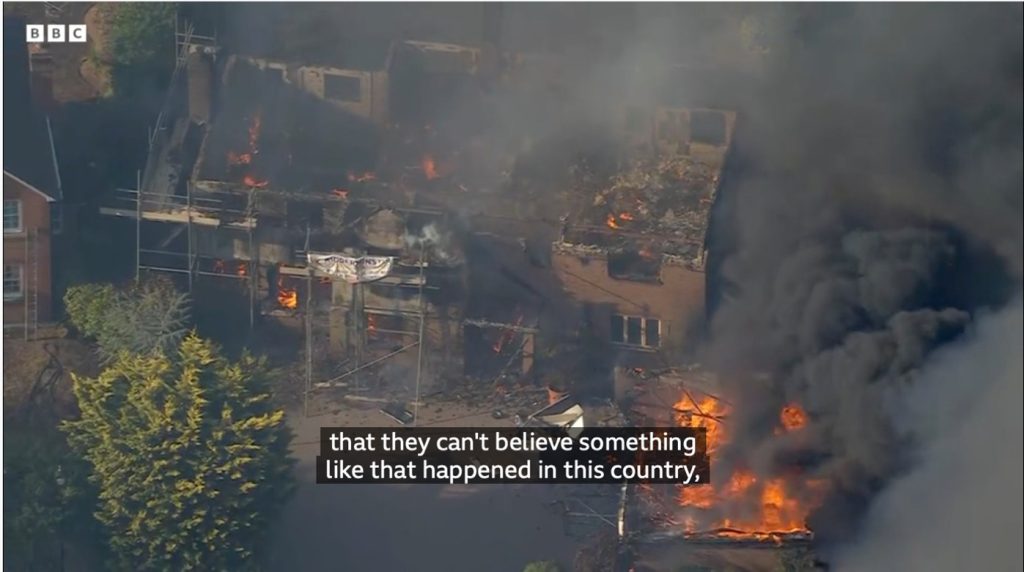
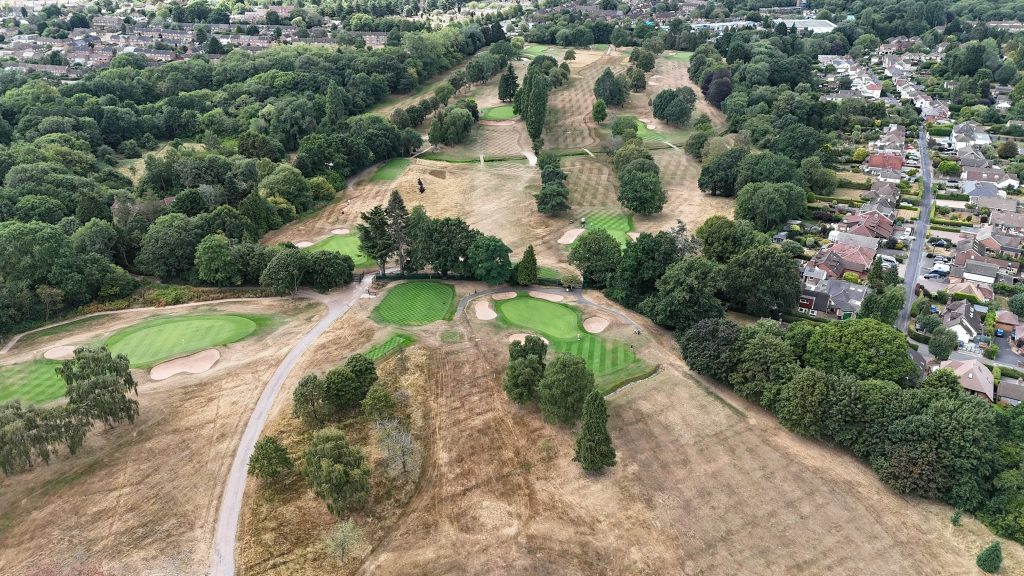
In ‘Crisis, what crisis?’ I showed one such image – the pyrocumulus cloud – cloud generated by wildfires with its own weather system able to start new fires miles from their origins. The wildfires have continued… Only now are they appearing to subside over the northern hemisphere. Our World in Data records 437,029 wildfires this year so far. In a demonstrably ‘First World Disaster’, a golf course caught fire and burned down 19 private houses in the reasonably well-off area of Stourbridge, West Midlands near where I used to work. (Figure 1) In my old patch, Sandwell, nearby, there were 24 wildfires in 17 locations, some started deliberately. Climate reality is coming home. People are waking up – their interest and concern is gathering in the UK for the National Emergency briefings. People near golf courses are uneasy… (Figure 3) “They can’t believe something like that happened in this country.” (Figure 1) The new UK prime-minister has responded by banning disposable barbecues.
On August 26th, a glacier collapse on the Nepal-Tibet border area of the Himalayas sent a wall of ice, rock and water 300 metres wide and a 100 metres tall crashing down at over 120 kms an hour, destroying the border command post in an instant, creating extensive flooding further down the valleys, leaving over 1200 people dead with 2000 still unaccounted for. The head of the International Centre for Integrated Mountain Development (ICIMOD) proposes the disaster be known as the Lirung ice-rock avalanche. Many more such ice-rock avalanches can be expected as the climate warms up. For those involved in preparedness and response, questions arise, not just about the extent of early warning systems for disasters around the world, but how ordinary people resident in zones at risk know how to respond when the warnings come.
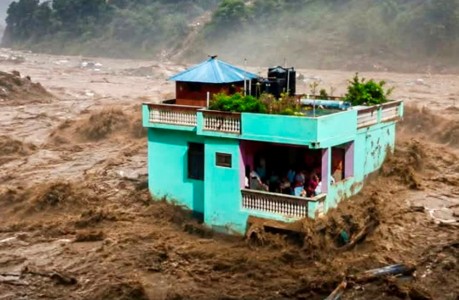
For me, the image of climate change, replacing the polar bear on the ice flow, is now ‘the Turquoise “Miracle House” in Trishuli, in the Nuwakot district of Nepal— the Pyakurel family home that survived the glacier-collapse flood on the Trishuli River. (Figure 4) As boulders the size of houses crashed down the river valley, the house was miraculously spared. This is a striking symbol of the catastrophe that happened, but also an image of survival and hope.
A blind eye
Some of our politicians still deny climate change, dismiss it as a hoax, tell us just to enjoy the summer heat. Most of them are well rewarded by fossil fuel funding. They are turning a blind eye, rather than showing vision.
A dark vision
If there is a vision, for many of our leaders it is a dark one. Naomi Klein and Astra Taylor call it, End Times Fascism. An unholy alliance of leaders pursues ‘Armageddon’, in all its forms from every fundamentalist religion, technological oblivion or escape to another planet, and ethno-nationalist end-timers believing themselves to be holding back barbarians and infidels. The wealthiest people on earth are committing their wealth not to eradicating world hunger, or fighting climate breakdown, or stopping conflicts, but buying politicians and elections, lining their own pockets and engaging in the race for technological destruction. They are fuelling division, monetising hatred, and profiting from the extinction, that they themselves are accelerating. The best truly lack all conviction, and the worst are full of passionate intensity in this, Second Coming. It is essential for the future of our health, our children’s health, and the future of our planet, that public health figures bring us back from the edge of the cliff that these dark leaders are taking us to.
The opinions expressed in this post are solely those of the author and do not necessarily represent the views of GNAPH or its members.
My geopolitical summer
WFPHA Global Public Health Week webinar. The Links Between Geopolitics and Public Health: A Joint WFPHA PET and GNAPH Webinar, April 8th, 2026. World Federation of Public Health Associations. Michael Moore (AUS) chair. Participants: Bettina Borisch, (CHE) CEO WFPHAs, Chuck Johnson (USA) IPPNW, Melissa Sweet, (AUS) Independent health and environmental journalist, Duha Shellah (PAL-CAN) John Middleton (UK) GNAPH, Mary Codd (IRE) ASPHER. https://www.youtube.com/watch?v=YZZeLS5YppU&feature=youtu.be
EUPHA Public Health Week. Health peace practitioners’ initiative. Peace, polycrisis and public health – Role, mission and mandate of public health professionals. Panel discussion. Friday 8th May 2026. European Public Health Association. Farhang Tahzib, chair, Bettina Borisch (WFPHA), Rachel Handley (UK) , Sara Lavinia Brair (Sudan), John Middleton (GNAPH) Erika Wichro (Int)
Poster paper abstract. Konyard K, Levesque S, Middleton J, Codd M. Public Health Education in Times of Geopolitical Disruption: Developing a Subject-specific Curriculum in Geopolitical health. Royal College of Physicians Ireland (RCPI) Faculty of Public Health Medicine Summer Scientific Meeting 2026.19 and 20 May 2026. Irish Journal of Medicine. Ir Med j June 2026; 119 no 6: 119. Page 18 of book of abstracts https://imj.ie/royal-college-of-physicians-ireland-faculty-of-public-health-medicine-summer-scientific-meeting-2026/
Misneach i dtréimhsí dorcha ar son sláinte an phobail/ Courage in dark times for the health of the public. Keynote for the Summer conference of the Faculty of Public Health of the Royal College of Physicians of Ireland, May 19th 2026. https://www.slideshare.net/slideshow/courage-in-dark-times-global-public-health-challenges-and-strategies/287662536
Short presentation for the Medicine Sans Frontieres side Event at the World Health Assembly, May 20th, 2026. Climate crisis peace and the right to health and healthy environment. Closing comments by Professor John Middleton. https://vimeo.com/1205481827
Centre for Health and Development Staffordshire University. CHAD/FPH Webinar. Middleton J. Geopolitical health a new imperative for understanding the health of the people we serve. Webinar lecture presented, June 8th, 2026. https://www.chadresearch.co.uk/chad-fph-webinar-geopolitical-health-a-new-imperative/ Speakers slides: https://www.chadresearch.co.uk/wp-content/uploads/2026/06/20260608-FINAL-delivered-middletonj-CHAD-middletonj.pdf You tube lecture presentation: https://www.youtube.com/watch?v=ud_XFuP2USs
Geopolitics, ethics and public health. ASPHER 1st congress on public health education and training Milan, July 16-18th 2026. https://milan2026.aspher.org/programme.html Poster presentation. https://www.aspher.org/media/resources/structure_30/resource_57/Milan2026_P-01_Thu_1100-1230.pdf
World Congress of Public Health, Cape Town, September 6th 2026. Presentations. Population Medicine WCPH Abstract book https://www.populationmedicine.eu/Issue-1-2026,17050
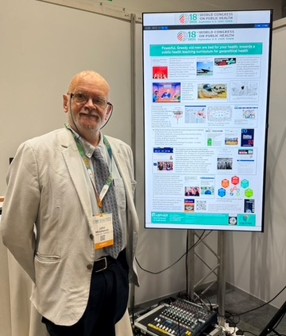
Abstract No: ABS3210 ‘Powerful, greedy old men are bad for your health’: Towards a public health teaching curriculum for ‘geopolitical health’ John Middleton1, Sebastian Levesque2, Karl Conyard3,2, Mary Codd3,2 1Office of the President, Global Network for Academic Public Health, Washington DC, United States, 2Association of Schools of Public Health in the European Region, (ASPHER), Brussels, Belgium, 3School of Public Health, Physiotherapy and Sports Science, University College Dublin, Dublin, Ireland. Popul. Med. 2026;8(Supplement 1):A3195
ABS3534 No Health Without Peace: Public Health Leadership for peace, health and justice in a world in turmoil Farhang Tahzib1,2,3, Mary Codd4, Katarzyna Czabanowska5, Joseph Mfutso-Bengo2,6, Laura Magana7, Emma Rawson-Te Patu8, Fatai Ogunlayi3, Tracy Daszkiewicz3, Mehreen Hunter8, John Middleton2 1European Public Health Association, Utrecht, Netherlands, 2Global Network for Academic Public Health, Washington, United States, 3Faculty of Public Health, London, United Kingdom, 4Association of the Schools of Public Health in European region, Brussels, Belgium, 5WHO Collaborating Centre for public health leadership and workforce development, Maastricht, Netherlands, 6Association of the Schools of public health in Africa, Nairobi, Kenya, 7Association of the Schools of Public Health and Programmes, Washington DC, United States, 8World Federation of Public Health Associations, Geneva, Switzerland Popul. Med. 2026;8(Supplement 1):A3278
ABS3025 Strengthening collaboration for public health action: equity, inclusion and sustainability in an age of populism and Fragmentation. Alison McCallum1, Ariane Bauernfeind2, Meri Koivusalo3, Avi Magid4, Henrique Lopes5, Mary Codd6,7, Colette Cunningham8 1Centre for Population Health Sciences, University of Edinburgh, Edinburgh, United Kingdom, 2Andalusian School of Public Health, Andalusian School of Public Health, Grenada, Spain, 3Tampere University, Tampere, Finland, 4International Health, Maastricht University, Maastricht, Netherlands, 5Nova IMS, NOVA University, Lisbon, Portugal, 6University College Dublin, Dublin, Ireland, 7ASPHER, ASPHER, Brussels, Belgium, 8University College Cork, Cork, Ireland Popul. Med. 2026;8(Supplement 1):A3192